Wednesday, January 11, 2017

Being Beguine (Dec 2016)

Originally published December 5th, 2016



img_4872

My fascination with Catholic nuns, my ever-on radar for nun-news, comes not so much from having grown up with them all around, but the fact that they are going extinct.  (If someone knows of a Catholic nun revival surge, please point it out to me.) 

It is the fact that we are alive to witness the extinction of a twelve-hundred-year-old tradition that is fascinating.  It is the fact that they ‘stood by their men’ through some pretty egregious happenings that suggests extinction is inevitable, perhaps even karmic.

As a child educated in a Catholic school, I had to swallow some pretty bizarre concepts, presented to me as ‘truths’.  The pope is infallible.  Purgatory is a place.  The Holy Ghost is a thing.

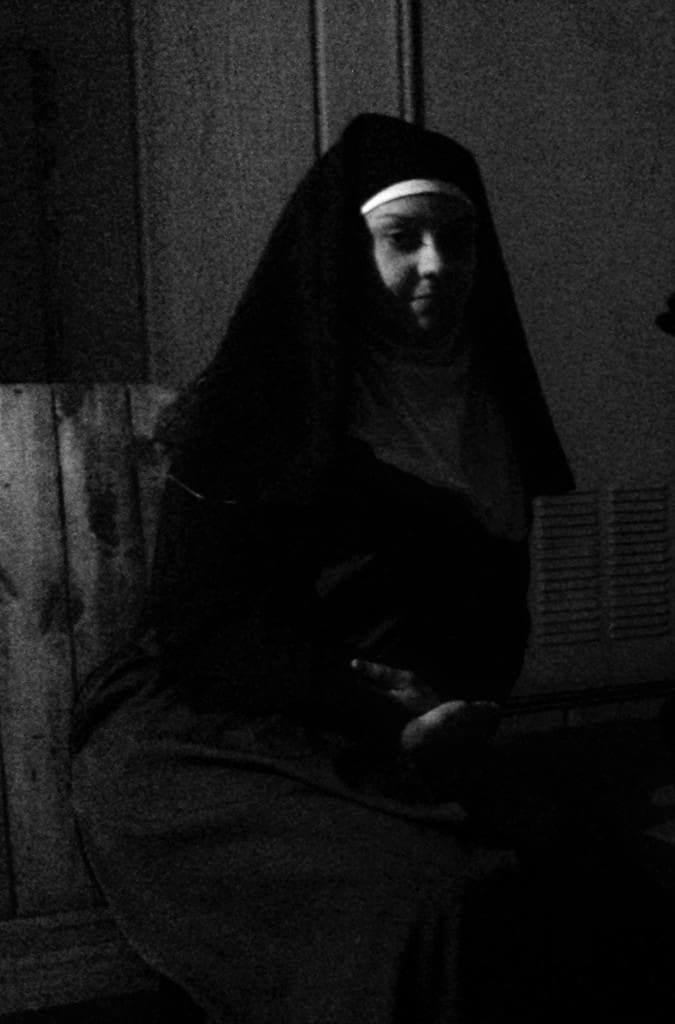
Recently, I heard a modern-day Catholic nun tell a news reporter that the white habits they wear represent being married to God.  She said they put on their wedding dresses every day to celebrate their anniversary of marriage.  The nuns I grew up with wore black, so I never heard of such a thing as the habit being a wedding dress!

It got me to thinking.  If no-one objects to the rather bizarre notion that nuns wear their wedding dresses daily, to re-live their marriage to God, then certainly people can wrap their heads around the concept of a Sisterhood of women who work with cannabis plants, make home-made tonics and tinctures, and support themselves through their own labors and without need of alms?

Our earth family should be able to accept the fact that we wear the gowns to honor our ancient Beguine fore-mothers, that we put them on to show respect for the plant and Mother Earth, that we put them on to remind ourselves to make our sacred ancestors proud, that we wear them to announce our presence to the people, as regalia, to honor them, whenever we are among them.  Yet, word on the street is that our local officials can’t wrap their heads around this concept.  Yes, word on the street is that they are fine with our cannabis business, but not with our uniforms.  So I can only assume that if we claimed to be married to God, if we claimed our uniform was a wedding dress, then it would be ok?

img_4866

Actually, try as they might to make it about something else, we know too well why they object.  They object because there are no men in charge here.  They object because there is no male-founded, male-run, male dominated church here.  There are men here, of course, but they don’t run the show.  Furthermore, our order is ‘self-formed’ and, as ‘weed-nuns’, we are self-declared, which makes us empowered, and the old grey-haired white dudes running the central valley of California find that to be frightening.

In case you hadn’t heard, we are leaving a two-hundred-thousand-year-old period of male energies ruling the planet and are entering the age of feminine energies ruling the planet.  We are leaving our ‘conquer all’ mentality that formed our civilizations and we are entering an age of preservation, nurturing, nesting.  Of course, female energies must now rule, if we want to keep our people inhabiting this planet.  (Never mind Trump, Brexit, Geert Wilders, Marine Le Pen, and the others of their ilk, they represent the last gasp of a dying paradigm.  You didn’t think the conquerors would go down without a fight, did you?  But worry not -- hate is not a sustainable political platform.)

Before we bought our farm, we checked the history of the land to make sure no blood was spilled here.   We purchased as ‘near virgin’ land as is possible in these parts.  No animals were caged or slaughtered here, no one was ever hurt here, and we made a big upset in this place by putting a digger in the ground and splitting a line through the property diagonally, to lay electricity for lighting.  We had to do a special healing ceremony for the land, to repent for the cut we made.  The split in the land upset the energies of the property and made people who love each other quarrel and bicker.

img_4912

In the same manner that we checked the land and the house before offering to buy it, to make sure that the energies here were right for the women and the work to be done, we would not reach for a spiritual practice or religion that had blood on its hands.  If murders and pedophilia and dark plots lurk there in the history of the enterprise, we don’t want it.  
We are starting anew.

Our holy trinity is S.A.S.  Yes, because we are political activists, we do ‘give sass’ (now and again), as Brother Emery calls it, but no, the acronym stands for Service, Activism, and Spirituality.   The most important part of our ancient-wisdom medicine-making is the environment the products are made in.  Therefore, we sought a pure place.  An untarnished little farm, a little closer to the gangster-town than we might have preferred, but the land, all the same, is clean.

We would not do our Activism, if it required blood or harm to anyone.  Burning fuel to get to our events is harm enough, and we pray for forgiveness and try to double up.  We yearn for solar powered cars, but what we have is fossil-fuel-burning carriages.

We approach our activism and perform our activism with pure hearts, good intentions, and would not go where dark forces gather.  The intention of our activism is to inform, educate, elucidate, where the media machine would rather you remain ignorant.

In service to the people through the cannabis plant, we are working in a space of ‘no harm’, because try though they might, no-one has ever died from an overdose of the Cannabis medicine.

And finally, our spirituality.  We are Beguine revivalists.  

The Beguines pre-dated Christianity and though they lived together, dressed alike, and prayed together, their mission was not to spread any kind of dogma.  Their mission was to rescue women from poverty and give them independence and property (wealth).  They were very good at it.

They were so good at it that during different times through-out their history, they were persecuted by different religious and political groups – mainly because the products they made were of such consistently high quality, and because their work had garnered them such loyal followings.  The attacks on them were for jealousy of their success, and because the Beguine mission was to empower women.    Our research indicates that in medieval times in Europe, many towns had Beguine villages within their castle walls and many travelers came from far and wide to purchase their products.

img_4059

Eschewing Christianity is not because we are ‘anti-Christian’ – we are not.  It is simply that our practices identify with our pre-Christian mothers, those early enclaves, whose stories and practices were largely lost to history because they existed before books and written records.  Because of the lack of information, we must use our own imagination and intuition to build something akin to what their lives would have been.

This Yule Tide Season, I want a book on the Beguines, and more importantly -- time to read it.  But I am interested in the ancient Beguines, not the ones that recorded history is most likely to discuss – the Catholic Beguines.  

The first Catholic nun didn’t come about until the late 800’s, and I am interested in the enclaves of our Beguine mothers before that, because I am pretty sure that their conversion to Catholicism was coerced.  And that this move to Catholicism actually accelerated their extinction (just a personal theory at this point).

Because Christianity (widespread) happened when the first books became distributable, one might falsely come to the conclusion that our Beguine mothers were Catholics.  That would be un-true.  The Beguines were around long before Catholicism became mainstream.  The Beguines thrived during the dark and middle ages, when daily life was not so well documented, but just because it isn’t written, doesn’t mean it didn’t happen.

It’s not a surprise that the first book mass produced was the Bible, because the man who developed the printing press was Catholic.  I have to say I’m a bit surprised and pleased with the blunt Wikipedia entry on the history of the Bible (and the added apology to Catholics).

By 500 A.D. the Bible had been translated into over 500 languages. Just one century later, by 600 A.D., it has been restricted to only one language: the Latin Vulgate! The only organized and recognized church at that time in history was the Catholic Church of Rome, and they refused to allow the scripture to be available in any language other than Latin. Those in possession of non-Latin scriptures would be executed! This was because only the priests were educated to understand Latin, and this gave the church ultimate power… a power to rule without question… a power to deceive… a power to extort money from the masses. Nobody could question their “Biblical” teachings, because few people other than priests could read Latin. The church capitalized on this forced-ignorance through the 1,000-year period from 400 AD to 1,400 AD knows as the “Dark and Middle Ages”.

Pope Leo the Tenth established a practice called the “selling of indulgences” as a way to extort money from the people. He offered forgiveness of sins for a fairly small amount of money. For a little bit more money, you would be allowed to indulge in a continuous lifestyle of sin, such as keeping a mistress. Also, through the invention of “Purgatory”, you could purchase the salvation of your loved-one’s souls. The church taught the ignorant masses . . . Pope Leo the Tenth showed his true feelings when he said, “The fable of Christ has been quite profitable to us!”

Editorial Note: Let us state at this point, that it is not our intent to offend or “bash” Roman Catholics. It is unavoidable that every historical account has its “good guys” and its “bad guys”. Just as it is impossible to accurately tell the story of World War Two without offending the Germans and the Italians who were undeniably the enemies of world peace at that time… it is equally impossible to accurately tell the story of the English Bible without unintentionally offending those who continue to revere the Roman Catholic and Anglican Churches.
20160925_190015-2

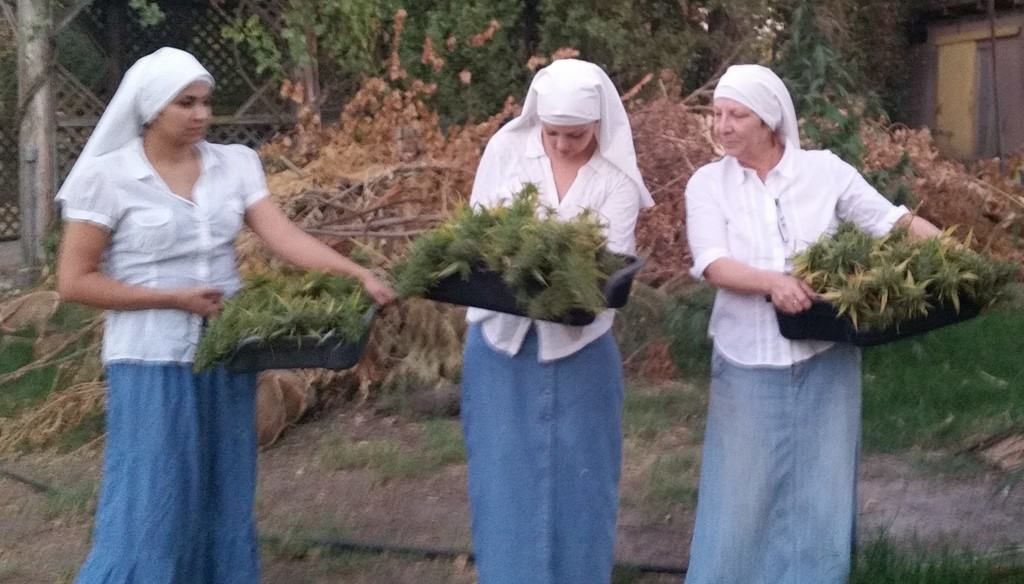
The Beguines thrived during the dark and middle ages.  They were focused on helping the women.  Their methods and order and spirituality drew women of all classes.  They built housing and many devoted their lives to the enclaves and when they died, left their wealth to the enclave so more unfortunates could be brought in, taught a trade, put to work, given honorable lives.  They didn’t live in the same house, but clustered their homes.  They owned businesses and houses, grew their own food and hemp and made clothing for themselves and to sell.  They made medicines for themselves and to sell.  They made jobs.  That was their mission.  That is ours.

Right now, this planet has a lot in common with the dark and middle ages.  Just like back then, women and children suffer the brunt of the poverty stick.  Just like back then, there is a certain hopelessness that sickens the spirit, when people cannot have gainful employment.  There is a malaise that happens when the deck is stacked against you – born poor, die poor.  We are re-living that again.  I call it the castle syndrome.  But we, the descendants of the Beguines, intend to occupy the castle, as our ancient mothers once did.

Samain* Season at the Abbey (November 2016)

Originally published November 2, 2016

*pronounced Saa-ween or Saa-win

Samhain's long association with death and the Dead reflects Nature's rhythms. In many places, Samhain coincides with the end of the growing season. Vegetation dies back with killing frosts, and therefore, literally, death is in the air. This contributes to the ancient notion that at Samhain, the veil is thin between the world of the living and the realm of the Dead and this facilitates contact and communication. For those who have lost loved ones in the past year, Samhain rituals can be an opportunity to bring closure to grieving and to further adjust to their being in the Otherworld by spiritually communing with them. (Selena Fox)

This year at the abbey, Samhain was another trip down ancient lane.

To accommodate the children and their modern-day custom of ‘Halloween’, the Sisters weren’t able to practice all the pieces and parts together, but beginning at sundown, we managed to get in all the seven services of Samhain and by the time the bonfire was lit, we were together as one.


20161031_182311


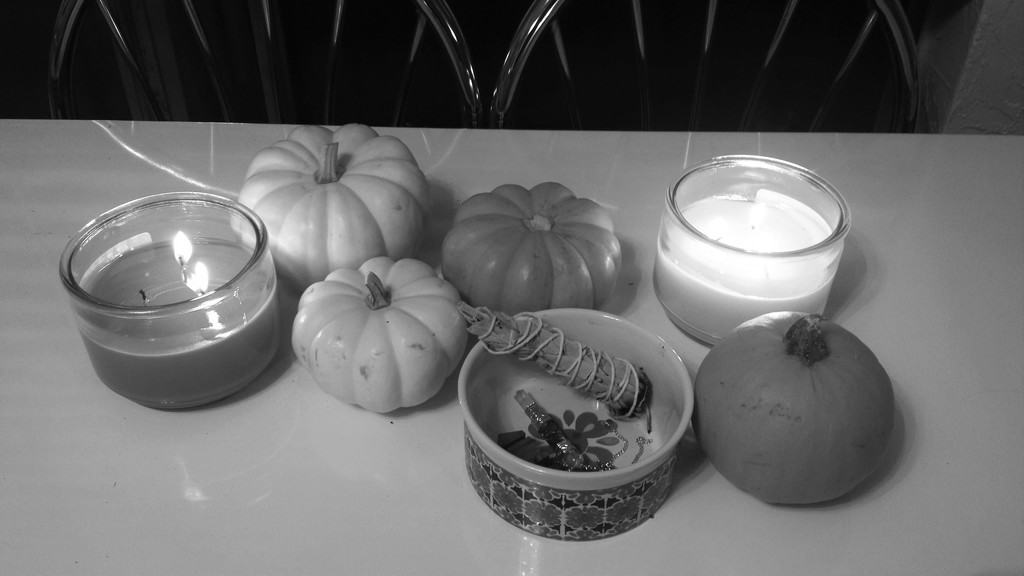
With the coming of sunset, one Sister arranged the pumpkins and candles on the feast table.  She then joined an older Sister for a meditative walk through the countryside, setting the energies for the evening.  Meanwhile, one Sister was out trick-or-treating with the young ones, and would, no doubt, be late to dinner.


20161031_191512-2

A harvest meal, made by the loving hands of the day-time staff, was shared in a prayerful environment, in honor of the ancestral spirits.  Simple fare . . . potato kale soup and a vegetable pine-nut pasta salad, with several kinds of bakery breads. 

20161031_184529-2

One Sister prayed over the feast table, taking special care to invite ancestors from the other side to join in the Feast of the Dead.  The table was set with an extra place as is custom, with a filled plate and bowl and wine glass, later set outside for easy access by the spirit world.

After dinner, two Sisters consulted their pendulums for predictions of the coming year.  Outside, the men built the bonfire.

A solemn ceremony was held.  The Sisters gathered around the fire, robed in their formal gowns, holding hands and chanting, “We are the circle, within a circle, with no beginning, and never ending.”

There were prayers of thanksgiving and prayers for the coming years’ blessings.  There were prayers offered for those recently departed and those who have long departed the earth plane.  There were individual prayers and prayers for the Sisterhood. 

The women took their candles and sang as they moved first counterclockwise, then clockwise around the bonfire:    “Sacred Ancestors come to me, Sacred Ancestors please help me, All my Mothers, Fathers, Brothers, Sisters, and Relations, too, Who have loved me for always, I’ll keep the light for you.”

20161031_214119-3

And the service ended with an ancestral story:

Imagine that we are standing at a bonfire in Northern England in the year 50 of the current era.  Christianity wasn’t a thing, yet.  The Bible was centuries from being written.  The country had been torn up by one war or another for the past fifty years and the people and the land had not yet recovered.  But here stand the women, ‘round the fire, on land recently conquered by the Romans.

Take yourselves there, to their fire. The women are gathered as we are, to pray, to talk.  Let’s sit. It is cold there, so they gather close to the fire.  

They share information that is not for others’ ears, so they gather close to speak softly and still be heard.These women, like many of us, have children.  These women, like many of us, are raising those children alone.  These women had to fight to get a loaf of bread each day and spent much of their precious lives begging or borrowing.  They knew they were not alone.  They knew they weren’t ‘special’.  They knew the men could join the military machine and get food, but their choices were far less.  They knew that other women, all the women, suffered the brunt of the poverty. 

“I have heard the Romans wish to end the conflict, to civilize this place, and live peacefully.”  Said one woman at the fire.  She paused before she continued and then spoke with unabashed hopefulness:   “There will be jobs, and medicine, and food.” 

Another Sister at the fire countered her:   “We will just be slaves for them and the profit will go to Rome.”

But then another Sister interjected an idea, a good idea.  “We must begin our own business.  We must own and control something, something that is ours, that will keep us safe.”
“They are allowing us to grow hemp,” says another woman, another face around the fire.

What followed, then, was a serious conversation about what was needed and how those needs could be fulfilled, so that the women could begin participating in a newly de-regulating business.  What followed, then, was a serious conversation about making jobs, creating housing and food security, through farming, textiles and medicine.  What followed, then, was an all-night conversation that didn’t end until the sun began to show its light. 
That night, at their fire, an era of empowerment was born.  This is not uncommon.  Women create in more than one way.

That night, at the fire, a lifetime of purposeful living, a life-time of sustenance for themselves and their children began to manifest.   That night, hope and purpose was re-born in the embers of the Samhain fires. 

And these are the ancestral mothers whom we honor and emulate.   These are the ancestral mothers whose blessings we pursue.

20161031_213404-2

Taking a Trip on the Good Ship Could've Been (Oct 2016)

Originally published October 8th, 2016.

I woke up at six a.m. intent on pressing and preparing all the gowns for all the Sisters.  Instead, I spent the next thirty minutes looking for our iron (found buried under clothes in a laundry basket) and no one in the abbey, or working for the abbey, got by that morning without a lecture on how irons are integral to being a sister.  How everything has a place and must be kept in that place.  How the iron is essential to our grooming.  How we can get away with being wrinkled for farm work, but not acceptable for activist events.  I was so annoyed.

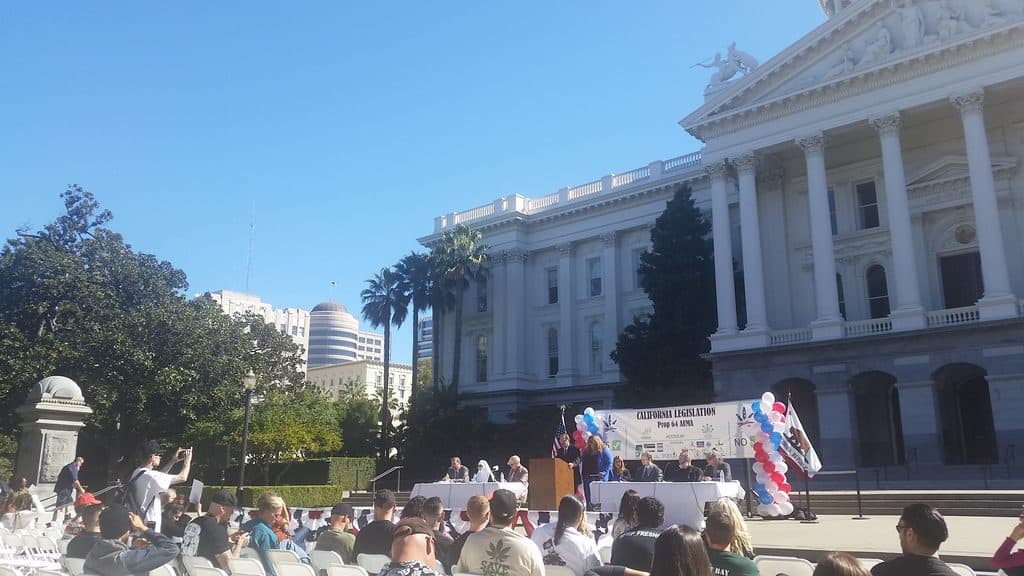
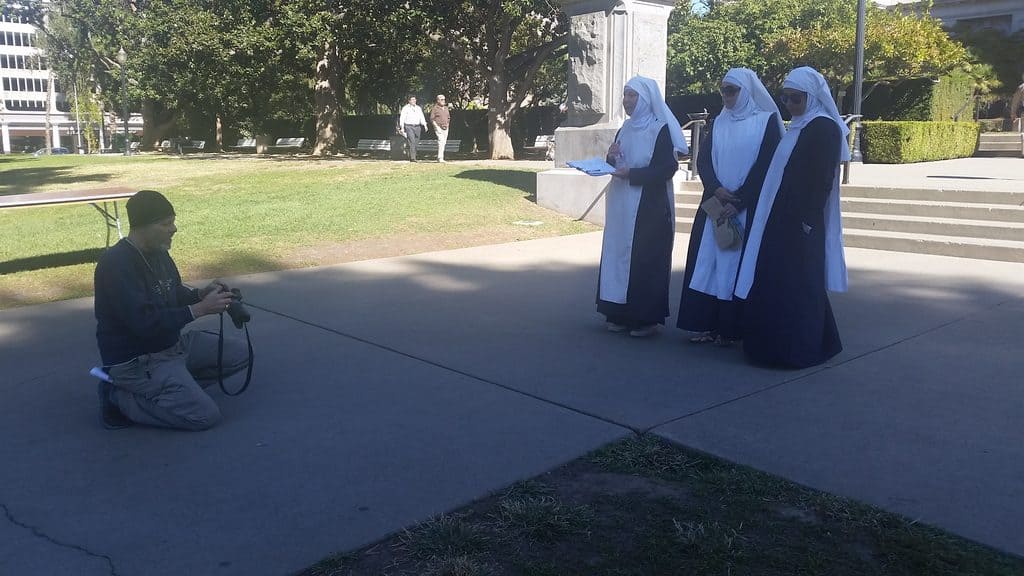
Nonetheless, I was smiling as I got in the car because at seven-thirty, on the dot, all road trip personnel were assembled, pressed and crisp, and ready to rock and roll.   And we pulled into the Capitol Building parking structure in Sacramento at precisely ten o’clock. 


The night before, I finally studied the sixty-page document that makes up Prop 64, the recreational marijuana legalization bill on the California ballot next month.  I knew I would be sitting at the Yes on Prop 64 table.   I knew my Sisters would be with the ‘Yes’ side of the audience.   It was being held on the Capitol steps, and politicians and media would be there, I was told. 

I saw no signs of either group in attendance, actually, but we did have a Citizens’ debate and that is the nourishment that drew me.  As activists, we are used to being ignored by both the politicians and the media.  That is just, yawn, status quo.

I went to Sacramento believing the debate would be – should we allow recreational marijuana or shouldn’t we?  I anticipated the tired old arguments about it getting in the hands of children, or encouraging use of it by all – kids and non-kids.  I quickly realized what my fellow panelists already knew. This debate wasn’t about that at all.
I asked for a show of hands from the No to Prop 64 side.  

How many of you don’t want to see recreational marijuana legalized?  No show of hands.  “Now, how many of you are sitting on the ‘No to Prop 64’ side because you think this bill is all wrong, too much power in the hands of the legislators, too much taxes . . .?”  I didn’t have to finish.  All the hands went up.

I was thrilled.  It appeared that every person there believes recreational marijuana should be legalized.  There was no debate from the people who say “NO” to rec. 

The debate became:  should we legalize now, with this big pharma bill, or should we wait and try to get it right, like Ohio did?  (Ohio passed on medical marijuana when the only bill on the ballot formed a four-company State monopoly.)  The voters didn’t reject it because they don’t want medical marijuana in their state, they rejected it because it was a corrupt bill and they know they can do better.  

I get it.  I understand and am empathetic to the No-on-Prop-64-because-we-can-do-better Team.  MCLR was better.  CCLR was better.  All of the initiatives that didn’t make it to the ballot, were better.  But guess what?  They didn’t make it to the ballot.  So our choice is now Recreational or No Recreational. 

To get Recreational cannabis, we have to put up with interference and taxation from eight different State agencies named in the proposition:

                Board of Equalization
                State Water Resources Control Board
                Department of Fish and Wildlife
                Department of Consumer Affairs
                Department of Public Health
                Department of Food and Agriculture
                Bureau of State Audits
                Bureau of Marijuana Control

We have taxation rights in here that will make sure the black market never goes away – which is, by the way, opposite the mission of the proposition.  We have a track and trace program that is just new chains, invented solely for keeping the plants and the people of the plants in chains.  I get it.  I agree, the other bills were better.  But the other bills aren’t on the ballot.  At this point, sticking with this argument is like taking a ride on the good ship “could’ve been”.


I used the analogy of human slavery.  The cannabis plant and her people have been kept in the dark, chained, beaten, starved, maligned, and cursed.  Now the slave-owner has extended sunlight and food, and lighter, more comfortable chains.  Prop 64 and all those agencies above who plan to feed off the sweat of the slave, they are, by their nature, racist, unfair, and the enemies of the cannabis plant.

But do we, the slaves, deny the sunlight, food and lighter chains?  With more than eight thousand felony arrests every year that will go away with Prop 64, can we afford to wait another day?

Here’s what Prop 64 does right:

Anti-corruption clauses restricting the licensing folks from dipping their fingers in the business.

Promotion of small business via a five-year delay before big grow licenses are issued.

Minors who deal or use will stop going to jail.  Stop draining their parents’ savings to keep them from going to jail.  Replaced with drug counseling and limited fines.   The drug counseling is free and the fines are less than what Fresno State charges a college student for j-walking.

It gives the courts authority to re-sentence people who are being penalized that wouldn’t be after Prop 64 goes into effect.

It re-affirms the Compassionate Use Act of 1996 and all those rights.

It prohibits liquor stores from selling cannabis (yeah!)

But mostly, it dis-empowers the police.  Every home in the state, every property, has the right to six indoor plants and the cities and counties can’t regulate that away.  This is a serious step for plant freedom.

If I was on the fence about Prop 64 before going to the debate, sitting up there opposite the anti-Prop 64 people was enough to push me all the way over, firmly, happily, with the Yes folks.  It’s because the No folks are angry and frustrated and apparently, desperate to get people to see it their way.

Here is some of the spin worth noting:
  1. THE BILL DOESN’T SAY ANYTHING ABOUT MEDICAL! They proclaimed this as if it is a great secret sin of the Proposition 64.  The truth is, Prop 64 is about recreational marijuana.  The governor and MMRSA have already got Medical on its path for over-regulation.
  2. IT ONLY ALLOWS FOR ONE OUNCE OF WEED TO CARRY! They proclaimed the unfairness of this based on MEDICAL needs of patients, they kept saying “This isn’t right for my veterans” (your veterans?) and one panelist claimed to smoke two ounces per day for his medical condition.  Those vets and that panelist can still have their two ounces a day, through the medical program.  We are talking about REC!  They kept mixing medical into the equation to confuse and scare.  (But seriously, anyone who has to smoke two ounces a day needs to look into concentrates and better weed.)
  3. MORE PEOPLE WILL GO TO JAIL THAN EVER BEFORE! This was a claim based on the fact that the old rules for MEDICAL (again, they couldn’t stop mixing issues) disappear at the end of 2018.  If a collective hasn’t gotten their license from the licensing board by then, then YES, they have to close and if they don’t, they will go to jail.  Does this sound like 8,800 felonies a year from Cannabis?  Do you think that there are 8,800 collectives a year that will be denied licenses and so all those folks will be imprisoned?  I don’t think so.  8,800 is the number of citizens per year that are being sentenced now, without Prop 64.
  4. They accused the YES team of working for big money.   To the left of me sat a hemp radio program host who spends all his life understanding the changing laws in the various states.   To the right of me sat a lawyer who went to prison for five years for growing cannabis for his dying mother.  And then there was me. 
  5. In their rebuttals, they would say things like, “Listening to them is like listening to Trump” and “We need a real debate”.  Yes, they said ‘this isn’t a real debate’ and now who sounds like Trump?
Their arguments were emotional, but there wasn’t much of an audience to hear them anyway and of the audience we did have, the majority sat on the No side.  Not "NO" on rec marijuana, just NO on such heavy handed legislation.  

While I was speaking, one man on the No side hollered “What do you know?  You don't pay taxes!  You work for the Vatican”.  That drew laughter from the folks who know us.  I replied, “We aren’t Catholic” and he said “Well, then, what the hell are you?”  Now that’s a good question.  

For the record, we aren't non-profit, we aren't in the psychotropics business; neither the recreational bills nor the medical marijuana legislation really apply to us -- neither of them do, and for the record, we pay all taxes and have no desire to be a tax-exempt organization, like, er, the NFL, for example.  No desire whatsoever.

According to every recent survey, Prop 64 is going to pass.  That’s not why I sat in the debate on the Pro-Prop 64 side, but the fact perhaps lent an air of confidence and calmness to the Yes side that the No table didn’t have.   Except for me.  I never do activism calmly.  But my debate-mates were calm.

The only legitimate argument for voting No on proposition 64 is because it gives the government too much control.  I don’t trust the government either, so we plan to activate against MMRSA (the marijuana control board) and we will make them reform.  But in the meantime, we will not refuse the sunlight, nourishment and lighter chains.


Saturday, June 25, 2016

Merced County Elections and the Fate of the Cannabis Plant


County Elections

Just a month before the June primary elections, Sister Darcy and I released a political video plea, to urge disenfranchised voters to vote, and to kick-off our ‘anybody but whitey’ campaign to get some people of color on the dole (in the lawmaker position) because Mother Earth and the Sisters agree that people of color are friendlier toward plant-based medicine. 

People of color (around here, in my experience) never bought into all the lies about cannabis, and many still remember a grandma, aunt, or other female relative who made liniments and tonics from the plant.  This person they remember is always someone they loved, always someone they honored, and always someone that they couldn’t demonize with a reefer madness slant.  It wouldn’t fit.  So even the crisply suited Latino businessman who wouldn’t touch the stuff and strictly enforces a no tolerance rule with his nieces and nephews and children, even he knows its medicine. 

At the risk of sounding like Donald Trump with my sweeping observations, here’s how I see it:

White man tells his kids not to touch the devil’s weed, because white-man is naïve and trusted his government, who lied to him on this subject.

Mexican man tells his kids not to touch the devil’s weed – because he knows what white man does to his people when they use plant-based medicine.  The same thing white man has done from the beginning of their conquering days, demonize and criminalize what isn’t theirs.

So what does come to us from white-man culture?  Alcohol and pills and judgement of anything not understood.

From my perspective, all the intelligence about the cannabis plant has been unevenly distributed to the people of color.  Just like skin pigmentation, whitey got less.  

So what happened on June 7th?  Did we accomplish our goals?  Did we make any progress?  Do we have a shot at less white and more color in our lawmaking bodies for the November elections? For the sake of the plant and the people she heals?

The answer is yes, in some districts.

As an analyst, I am always interested in knowing if activism works.  Intuitively, I know it does.  But statistically?  You can never be sure of the measurement of that influence. 
I did some digging. It appears that since I moved to the Central Valley in 2008, the valley has gone blue. It has taken a decided turn for compassionate progress. I’m not saying that the Democratic party equals that, but for primary elections, June elections, with the lowest turn-out among elections, if you look at the numbers, you can see what’s happening here.

Since 2008, there has been a 42% increase in the number of ballots cast during the June elections.  Since 2008, there has been a 72% increase in ballots cast for the democratic side.  The number of registered voters has stayed the same over all that time.


I believe that the numbers tell us that we aren't getting new registrants, we would have to look at population shifts to know for sure.  But we are winning on getting them to the polls. Of course, it might have happened without us.  It might be happening because, as Anonymous famously says, “When enough people have their asses against the wall for long enough, they will rise up and claim their power.”  Maybe that’s what’s happening.  Certainly this trend tells me that the working class are waking up and coming out.

County Elections

There was no one candidate in any of the three districts with seats opening that had a clear majority.  Anyone with a clear majority wouldn’t have to run in November.  That didn’t happen, so we are off to the races.  The two candidates with the most votes face off in November.  So we need to force some cannabis debates.

District 1
Southern Merced reaching around and including Livingston, 
Planada, Le Grande and El Nido

The two that are competing for the district one lawmaker seat are John Pedrozo (incumbent, who ruled under the ban) and Rodrigo Esponozo, who sounds like he might be of a race that is more plant friendly. 

The Sisters have a vested interest in getting Merced to embrace cannabis and hemp as agriculture, because we have families in this district that would like to use their backyards to grow us organic CBD plant and earn money that we are currently spending out of the county.  The people of this District should be calling these two candidates to see where they sit on plant-based medicine, on embracing a thriving new industry on main street in our town, and make them debate publicly.  The one with the friendlier cannabis industry attitude wins.  I place my bets on the guy who isn’t whitey.

District 2
Central Merced

Lee Lor (our candidate) made it and she will be running against Hub Walsh who, if not stopped, will be doing his third term over the homicide capital, gangsta capital, meth capital of America.  We have more of those things per capita than any other place, and he talks like he’s done a good job.  And he wants a THIRD term!  Puh-lease.  We need to activate for Lee Lor and make sure she takes his position in November.


District 4
Gustine, North Merced, Ballico, Cressey, Winton, Snelling

Good grief.  We have two anti-cannabis bubbas who could spend a lot of money getting here and did, the former mayor of Gustine coming out of retirement because he wants to stay on the dole, against Lloyd, a wealthy white bubba from Snelling.  No good choices here.  The best we can do is perhaps force a debate?  Force them to come out on cannabis business for the county residents?  I don’t know what to say.  We lost on the ‘anybody but whitey’ campaign for District 4.  We are stuck in choosing between two white guys with money.

The city of Merced is going to vote to lift the ban on July 6th.  Mark your calendars.  They are going to lift the ban, but they are going to do it in a way that it will prohibit any cannabis commerce in their town.  They are planning to take back the states’ 12 plant per patient standard, and roll it back to six if not eliminate it.  They are not going to allow main street to have cannabis businesses.  You can be a tattoo parlor, a liquor store, a pill peddler, a porn shop on main street, but you can’t have Mother Earth’s most intelligent, healing plant.  And they are planning to put wide-net forfeiture clauses in to the licensing, so they are really setting someone up to lose all their property.  It’s bullshit.  They intend to make sure no smart businessman (woman) would set up in their town.

The fight is still on.  Cannabis is Agriculture.  Stand with us.  Pester your District dudes, call Merced city council members.  Be there July 6th.  They have to vote on their weak ‘pretend to lift the ban, but don’t really’ two times publicly.  July 6th is our first of two times to intercede. 
*****

For more about the Sisters, read the last blog, ‘Breaking Custom’.

Sunday, June 12, 2016

Breaking Custom


Our Sunday work rule in Sistah-ville is this:  If you must work on Sunday, do something creative or, at the very least, out of the ordinary. 

As I write this, I realize I’ve spent seven hours breaking our Sunday rule by attempting to answer the ga-zillion messages we’ve gotten on Facebook.  With one viral video getting over twenty million views in the span of three days, our phones, emails, social media messaging platforms are BLOWING UP.

We have lots of rules here at the abbey, and like any religion worth its salt, we have lots of breakage.  Turns out, I’m the worst.  But what do you expect from a nun who has her origins in anarchist activism?

Twenty Thousand Website Visitors in one day? 


Twenty Million views on a thirty-second news clip . . . WTH?

Since it is extraordinarily daunting, this massive attention we are currently getting, I put aside my rule-breaking correspondence chores to do something more creative -- to take up quill and hemp to paint pictures with words. 

If you scroll the thousands of comments under the twenty-million-viewed news-clip, you will quickly see that people are going ape-shit over the fact that we call ourselves nuns.  Actually, we were very used to calling ourselves Sisters, but the media called us nuns and we shrugged and went ‘ok – but make it ‘the weed nuns’, and thus, it came to be.

As women who feel called to their professions, called by the medicine, to the medicine, we are actually delighted that the public is going ape-shit over the habit, with not one word of malice toward the cannabis plant.  We are Mother Nature’s best decoys, it turns out.  They are too busy hating on us (on our clothes, actually) to notice that they are actually defending the cannabis plant as medicine!  

I think Mother Goddess smiles upon us every day, and says “You go girls!”.


Controversy Gets the Conversation Going

The media loves to distort things, and they like to leave much unsaid so as to coax emotional responses from the public. And it works!  But the Sisters and Brothers of this order are convinced that the conversation needs to be held, loud, and public, and often.  The Cannabis plant has, against science and truth, been maligned and lied about for seventy-five years and the lights have now gone on, and it is time for everyone to know, for everyone to see.  So we try to bury our indignation, when our earnings are over-stated or our mission is made to look greedy and capitalistic, because their spin is getting the conversation going.


We Are Not Catholic Nuns

You don’t have to look far to learn that we are not affiliated with any contemporary, and especially, any male-founded or male-run religions.  We are clear about that everywhere we go, everywhere we are asked, it’s at the top of the discussion forum on our website, at the top of the frequently asked questions.  We ARE NOT CATHOLIC NUNS.

We stand accused of ‘fakery’

First of all, it is no badge of honor to be associated as a cleric with the Catholic church these days.  They have much to atone for, and they know it.  So why would I want to pretend to be part of that group?  I don’t.  We don’t.  Wearing the Uniform gives us the burden of explaining where-ever we go that we are not Catholic nuns, but we do that, because we don’t want to mislead anyone and yet, it is time for a new age order of nuns.  The people miss them.

Second, the only time some stranger person has gotten angry with me is when he thought we WERE connected to the Catholic church and that poor young Sister Darcy has been forced to take a celibacy vow for life.   He stepped in front of our path and stopped us, as we walked down the street in Oakland. 

His head turned this way and that as he first looked at Sister Darcy, then looked at me, looked at her, looked at me, anger bubbling in his veins, thoughts of pedophile priests ruling the roost, and submissive nuns walking the boys to their victimhood (I imagined).  If his eyes could shoot arrows, they would have killed me.  Before he could utter a word however, I did what I always do and said, “We are not Catholic nuns.  In fact, we are a women-founded, women run, independent order of activist nuns.” 

I had him at the first short sentence.  His whole body relaxed as my words registered in his brain.  The tirade he stored up in his head floated away into the west coast sunlight.  He smiled, nodded, bowed respectfully, and allowed us to pass.


The Choice of Uniform was Deliberate

The transition from Sister Occupy (Fall, 2011) to where we are today is an interesting tale too long to tell here, but it definitely represents a journey towards a calling, towards the plant, towards the clearing of the fog, the dispelling of information, toward the shaming of those lawmakers who shame the plant medicine. 

In that journey, the ultimate decision was to abandon the Marion uniform that is so tightly associated with the Catholic church, in favor of something more in alignment with our political views – blue jean skirts best representing the ‘cannabis is agriculture’ movement.  We wear white blouses and white head coverings in order to set ourselves far apart from the Catholic sisters who have never, to our knowledge, worn such a combination.    

Our spiritual and medicine-making beliefs are based on getting in touch and staying in touch with our ancient wisdom, our ancient mothers and their practices.

We make medicine by moon cycle, as they did. 

We wear clothes that announce who we are to our tribal members, wherever we go, as a way of honoring them, as did our ancient mothers. 

We wear robes that represent devotion and connection to our order, as our ancient mothers did. 

Nothing about our choice of clothes has anything to do with the Catholics, but everything to do with culture.  We could have chosen for our clothing, the clothing of the ancient mothers of this land, in which case, we would have worn skins and beads and looked like Native Americans.  Or, we could choose to wear clothes more similar to those of our Northern European ancestors.  We knew someone would be offended, and chose to risk offending the Catholics over risking offending the Native Americans.  After all, the Catholics gained Native Americans to their culture by criminalizing their own native cultural practices, and gained lands by slaughtering whole tribes, so, the Catholics can take this perceived slight -- on the chin.


We wear very formal clothing to honor the plant that has been so dishonored this past century.
We wear very formal clothing in solidarity with our Muslim sisters who have privatized their sexuality by covering themselves entirely, as we do not believe that they should be the only culture on the planet wearing clothes our ancient mothers wore, to be modest, to be chaste, to announce which tribe they belong to, to honor their people via regalia.  All other religious cultures have gone modern or incognito.  Being alone in this makes Muslim women targets of discrimination.

Spiritual, Not Religious

We believe in and promote religions of one.  What Sister Darcy and I do in our prayers is not ‘religion’.  What we do is practice our trade, our gift, our calling, and we practice it in silence, prayer, and meditation.  We practice it with all our thoughts, with heart and soul, maximizing the healing powers through words, prayers, thoughts, hands, and elements of Mother Earth.  It’s not a religion; it is our work, it is our sustenance, and it is our calling.

We stand accused of standing behind religion for tax favors!

We are NOT a non-profit, because that would put us in the same category as the NFL, which is CLEARLY for profit.  

We are NOT a religion, because that would put us squarely in the same category of those who have been justifying ravaging mother earth and her children without missing a moment of a nights’ sleep, those who use the Bible to judge instead of help the poor. . . no thanks, religion hasn’t worked out so well for the planet, why would we want to be that?

We are a one hundred percent woman owned LLC and we pay all taxes just like any other legitimate business and to do otherwise would be against our own principals as we are trying to make tax dollars for these crummy little valley towns that need capital desperately – that need tax money to build things for the children to do (to build alternatives to meth)!


A New Age Order of Activist Anarchist Nuns

The Catholic nun is going extinct in this country.  I know, because I did a little research during my Sister Occupy years, and although the church is very non-transparent about this and all things (in a long-standing tradition), what I learned was that the nuns are going extinct.  There were 350,000 of them in America when I was growing up, there are now less than 40,000.  

The average age of an American nun is somewhere around 85 years old, the average age of a new recruit?  78.  They die at the rate of 10,000 per year and without recruiting young nuns, they are destined for extinction.  I believe some lost their housing to pedophile suits, so that could have contributed to the thinning of the ranks, as well.    

Even with the convents that are alive and well and have women under seventy-eight under the roof, the women don’t wear ancient garb.  They wear modern versions.  They abandoned the robes and we ‘occupied’ them.  And though Sister Occupy once wore black, Sisters of the Valley wear blue (blue jean skirts) and white or purple and white.

Purple is the significant color of the order because it is the color of suffering, the color of the occupy movement, and the color that you get when you melt together the colors of our bi-polar two party system.


What is a nun?

According to most dictionary definitions, a nun is defined as a woman who lives with other women in devotion to their work or prayer, they work together, live together, pray together and take vows.  

Nothing in any dictionary I saw said you had to be Catholic to be a nun. 

For the record, the first Catholic nun, after whom all Catholic nuns came, was Saint Scholastica.  She founded her order in the 800’s.  But at that time, the Beguines were the popular cultural equivalent and pre-cursors to the nuns of Catholicism. 

The Beguines were women owned, women run, clusters of houses around which hemp was farmed and all the women worked in the farming and textile industry together.  They lived together, in the sense of housing proximity.  They worked together in a spiritual environment.  They dressed in garb that identified their enclave.  They did commerce (textiles). They were all allowed to hold private property.  They were empowered.

The women owned all the property, the Brothers lived among them but made no significant decisions about the operations, and owned no property.  The Beguines did not take life-time vows.  They could leave and return, without barrier or stigma. 

I believe that Saint Scholastica’s first order was built on the dream of being them, but different.  My theory is that she wanted to be a Beguine, but her parents were Christians and the Beguines were self-empowered and probably not Christians.  Saint Scholastica formed her own version, connected to Catholicism, and added celibacy as a new twist on an old custom. 

Submission to a male-run hierarchy, with no female empowerment at the helm, that was probably considered heretical in those times.  If Saint Scholastica had social media to deal with, she would have been sick from the trolls and haters.  Or maybe not.  Maybe she would have smiled and said, ‘love me, hate me, just keep talking about me’, so that she, too, could fulfill her dream of expanding the order into something big and global, which, actually, she did!

A heck of a lot of nuns educated a heck of a lot of kids – planet-wide, in their time.  A heck of a lot of nuns served in many healing professions, as well, in their time.  I salute them for their service.

We emulate a standard of excellence in serving our customers.  But when we have to deal with hard decisions, we don’t say ‘what would the Catholic nuns have done?  What would Catholic sisters do?’.  No, we ask, ‘what would our ancient mothers do?’ and we believe those to be the Beguines.
We emulate a certain system and order to things.  Are we emulating the Catholic nuns who emulated the Beguines?  Or are we emulating the Beguines? 

We don’t believe that celibacy is required to be a spiritual and devoted woman.  We do take a vow of chastity and that is to privatize our sexuality in clothes and manner.  There is an element of celibacy to our practices, as we are celibate during the medicine making moon cycles, but that is a custom, not a vow. 


We take six vows for life:

1.       Devotion – We promise before Godfather and Goddess Mother to devote all of the days of our lives to the growing, making and distribution of plant-based medicines and to promoting the benefits of plant-based medicines and plant-based diets for Mother Earth and her people.    

2.       Obedience – to the Moon Cycles and planting cycles, to the goals of the Sisterhood

3.       Activism – to dedicate time each week to progressive activist causes that best benefit the economic conditions of the poor surrounding us

4.       Ecology – to honor mother earth in all we do, to do no harm during medicine making periods

5.       Chastity – dress and behave to honor the work we do, to honor our ancestors and our people

6.       Simplicity – a life of living simply (one car, one bedroom, one house, one TV set) – we do not believe it is necessary, with the wise, just, and ample distribution and use of Mother Earth’s gifts, for anyone to live in poverty.  As activists, we fight for the $15 minimum wage and work hard to create honorable jobs for the local people.

Offensive Things

If you are still offended by the co-opting of the ‘nun’ look that the Catholics copied from the Beguines and then, decades ago, tossed to the trash bins, hear this (please): 

There is much about society that offends us . . .

Citizens United, for starters.  The fact that we are re-fighting old fights or fights that are unquestionably already answered in the public consciousness.  Equal rights and equal pay for women and minorities and the LGBT community – fighting that in this day and age is offensive! 
Not yet having socialized medicine for everyone.  Trump.  Sending our boys off to wars that we orchestrate for profit.  Denying even bothering to explain what happened on 9/11.  The two-party system, the electoral college, the federal reserve.  The rigged economic system, operated by and for a few uber-rich. Profit on health care . . . profit on burials . . . profit on tuition . . . politicians who work hard to make sure government gets broken or stays broken, and then stand up and shout, ‘hey, you’re broken!’ . . . all this and more, offends us.    

Here’s the Thing:

We are humble medicine-making women who have not yet realized any profit from this venture.  Any monies made are re-invested in bigger batches and hiring more people who have given up on looking for work.  We reach for and employ the terminally unemployed.

We are working to shed light across the planet on the urgent need for all of us to save ourselves and save the planet by changing how we live and how we consume.

We promote plant-based diets, plant-based medicine, and a return to ancient ways.

We believe that the path toward a new way of living in harmony with each other and mother earth is lined with economic security, economic security that brings good health to the people naturally, economic security brought to the people via the cannabis plant, the hemp plant, and commerce in those exciting new (old) industries.

We are not your normal nuns.  We are, however, on a mission from God.

For more blogs, click here.
For the Sisters’ music video playlist, “inside and outside the abbey”, click here.